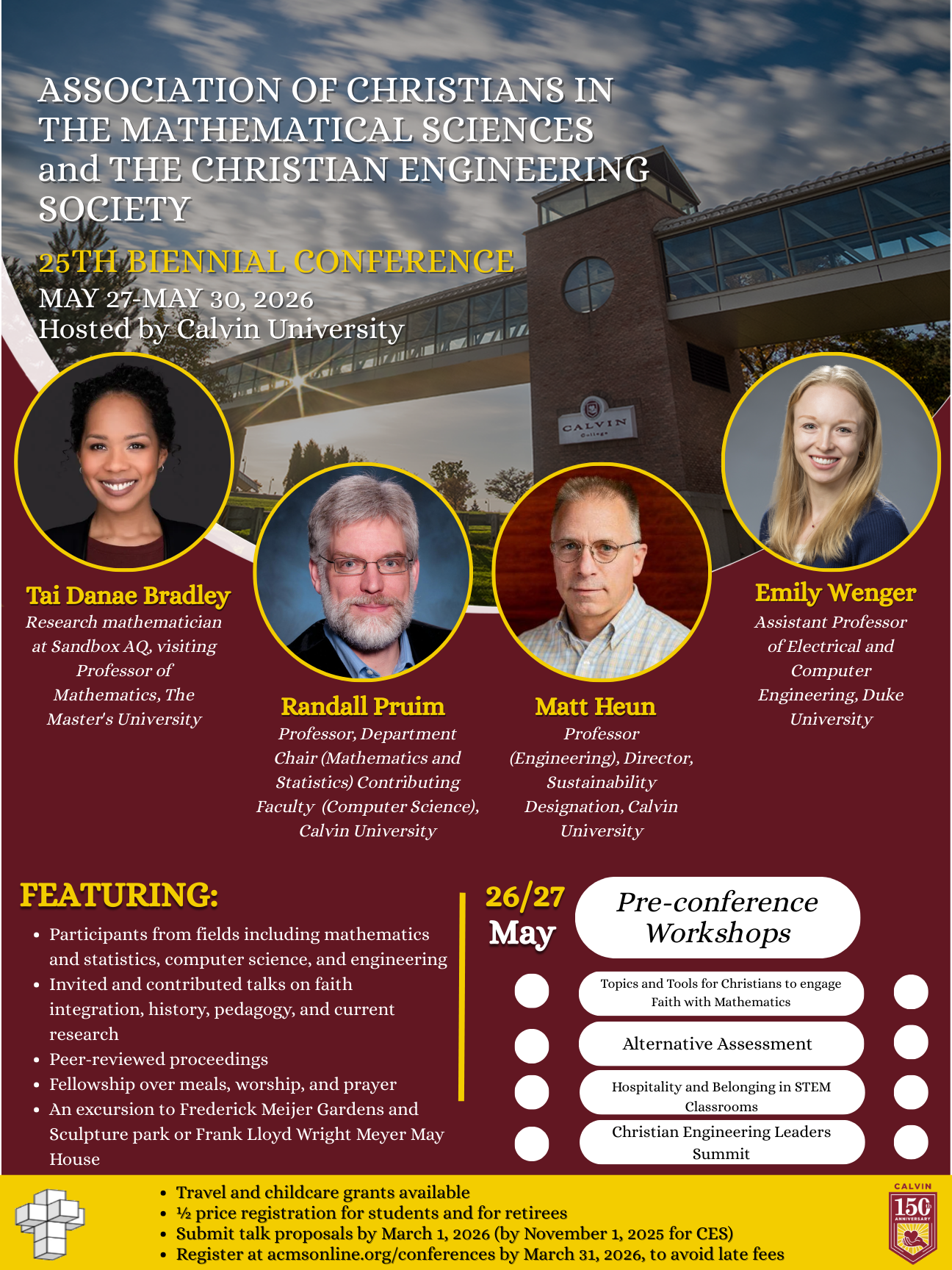
25th ACMS Biennial Conference
Christian Engineering Society Conference
May 27-May 30, 2026
Calvin University, Grand Rapids, MI 49546
Important Documents for Conference Attendees:
Note: all of these PDF files, except the last, will be printed out and provided in your conference folder.
2026 ACMS CES Conference Schedule
2026 ACMS CES List of Parallel Sessions with Titles and Speakers
- TLP CLEAR NSA CSI_NCP_SECURITY
- Careful Adoption of agentic AI services
- Interview with Glyn Gowing about AI from a Christian perspective
The main conference will begin with dinner on May 27 and will conclude with lunch on May 30. The conference will feature invited and contributed talks on history, pedagogy, faith integration, and current research in disciplines including computer science, mathematics and statistics, and engineering. Participants will enjoy fellowship over meals, worship and prayer, and a choice of excursion to either Frederik Meijer Gardens and Sculpture Park, or the Frank Lloyd Wright Meyer May House. There will be a formal banquet on Friday evening.
Invited Speakers
- Tai Danae Bradley (Mathematics), The Master’s University
Title: On the Record: A Mathematician’s Story of God’s Faithfulness
Abstract: In this personal testimony, I’ll share how my faith in Christ has shaped every step of my mathematical journey — from choosing to study mathematics, to launching the Math3ma blog, and much more. This is the part of my story that rarely gets told in academic or professional settings, but here, I’ll put it on the record: a testimony of God’s providence, kindness, and unwavering faithfulness in my life and career. - Randall Pruim (Statistics/Data Science), Calvin University
Title: Let’s Talk Ethics
Abstract: This talk will reflect on some experiences in my classes and among colleagues related to including ethics in what we do and teach. What makes this challenging? What make it rewarding? What resources exist to help us?
I’ll focus on “data science ethics”, since I’ve been teaching primarily data science and statistics courses in recent years, but I hope many of the ideas will be relevant in adjacent disciplines like mathematics, computer science, and engineering as well. - Matt Heun (Engineering), Calvin University
Title: Engineering: What are we doing?
Abstract: ABET defines engineering design as “an iterative, creative, decision-making process of devising a system, component, or process to meet desired needs and specifications within constraints.” But there is so much more! In this keynote address, we will explore what engineers do and why they do it. Furthermore, we’ll consider what Christian engineers do and why they do it. And I will suggest that our deepest faith commitments (worldviews) should and do both inform and affect the work of engineers, our understanding of the engineering profession, and our strategies for educating the engineers of the future. - Emily Wenger (Computer Science), Duke University
Title: Fighting for Creativity in the Age of AI
Abstract: Generative AI models are powerful — and complicated. While adept at classifying images, generating funny poems, and producing silly cat pictures, the development and use of these models may have unintended consequences. For example, there are growing concerns about how generative AI models harm creativity, both through unauthorized use of art for training and the bland, homogeneous outputs models produce. This talk will discuss research efforts documenting these consequences and explore possible solutions. It will conclude by considering a Christian response to the rise of generative AI.
Pre-Conference Workshops
Five pre-conference workshops will be held concurrently from Tuesday afternoon through Wednesday. Participants may choose one of the following options:
Workshop 1: Topics and Tools for Christians to engage Faith with Mathematics
Leaders: Cal Jongsma (Dordt University), Laura Smit (Calvin University), James Turner (Calvin University), Kevin VanderMeulen (Redeemer University)
Abstract: This workshop explores some philosophical frameworks and historical perspectives that the leaders have found helpful for engaging Christian faith with mathematics. The workshop will present an overview of important questions and perspectives for engaging in mathematics from the viewpoint of the Christian faith. The workshop will employ two different streams of thought. One stream will explore beauty and mathematics/theological aesthetics, rooted in the work of Aquinas, and another stream will explore a framework drawing on neo-Kuyperian reformational philosophy. These two approaches will address questions and perspectives in different ways and will both present ideas that participants can use to inform classroom teaching and scholarship.
Timeframe: Tuesday afternoon, Wednesday morning, and Wednesday afternoon
Workshop 2: Alternative Assessment
Leaders: Amanda Harsy (Lewis University), Sarah Klanderman (Marian University), Vic Norman (Calvin University), Adam Schultze (Lewis University), Michael Smith (Lewis University), Cara Sulyok (Villanova University)
Abstract: Traditional grading can lead to anxiety, discourage productive struggle, and fail to reflect student learning. Alternative grading methods, such as ungrading, specifications grading, contract grading, and standards-based grading, offer more transparent, equitable, and growth-oriented ways to assess students. This pre-conference workshop will serve as a community of practice to explore alternative assessment and to provide a chance to redesign a course you plan to teach in the 2026-27 academic year. Whether you have never heard of grading for growth or have been iterating on alternative assessments for years, come for resources and support to try it yourself.
Timeframe: Tuesday afternoon, Wednesday morning, Wednesday afternoon (optionally)
Workshop 3: Hospitality and Belonging in STEM Classrooms
Leaders: Rachel Baker (NetVUE), Crystal Bruxvoort (Calvin University), Stacy DeRuiter (Calvin University), Jennifer VanAntwerp (Calvin University)
Abstract: Successfully supporting a student’s sense of belonging in a classroom is not always straightforward. The strong cultural climate of STEM spaces can leave people feeling like they must adapt and conform to existing norms. Such attempts to “fit in” can create additional mental and emotional work, reducing a person’s overall ability to perform well. Not surprisingly, this is even more likely to be a problem for underrepresented groups.
Many training materials on belonging focus on motivation and knowledge: building awareness of one’s own biases and increasing knowledge of the types of barriers that can exist. Instead, we aim to provide concrete strategies to change the classroom environment.
This workshop should equip you to:
1. Recognize moments in the classroom that communicate to some students that they do not belong;
2. Provide strategies for responding to those moments, and some initial practice at implementing them; and
3. Touch on resources to consider if you would like to help prevent these moments from occurring in the first place.
Why join us? Belonging encompasses the feelings of being accepted, supported, and included in a group. To truly thrive in any setting, humans require a sense of belonging. And the social science and education literature also suggests that belonging allows people to focus better, think more creatively, and collaborate more effectively. This universality is not surprising from a Christian perspective; humans were created to be in these “right” relationships, first with God and then with each other. As instructors, working to foster belonging is one way of offering hospitality to our students and encouraging their success.
Timeframe: Wednesday afternoon
Workshop 4: Christian Engineering Leaders Summit
Leaders: Michael McGinnis (Engineering Dean at Letourneau University) and other volunteers
Abstract: The purpose of this gathering is to provide an opportunity for Christian leaders in engineering education (deans, department chairs, program chairs, or directors) to network, collaborate, and share best practices. By meeting together, we hope to build relationships and leadership capacity to strengthen and grow our programs for the building up of God’s Kingdom. The first summit took place at the Christian Engineering Conference in 2024 at George Fox University. A second summit was held virtually in July of 2025. A detailed agenda will be provided later, but items for discussion will include:
- Sharing and developing strategies for resource sharing and partnerships
- Managing ABET accreditation
- Identifying and addressing challenges and opportunities for faith-based engineering education
- Building engineering servant leadership skills
- Fellowshipping and supporting each other in our common mission
Timeframe: Wednesday afternoon
Workshop 5: A Common Call
Leaders: Dusty Wilson (dwilson@highline.edu)
Abstract: This gathering is for Christian faculty and graduate students who desire to live out their faith in the secular academia. For many, this conference (organized through Faculty Commons) has been a life-changing event in perspective and vision. You’ll meet faculty, staff and graduate students who will encourage and challenge you. You’ll hear about resources and strategies that can help you be more effective in your life and service. You’ll be refreshed to be with other faculty and graduate students who share “A Common Call.” We also welcome spouses to attend.
For more information about the speakers, click here.
Timeframe: Tuesday dinner opportunity, Wednesday morning and afternoon
Registration Links
Faculty and Professionals: REGISTRATION HAS CLOSED.
Retirees/students (conference fees are 1/2 price): REGiSTRATION HAS CLOSED.
Session Proposals
ACMS Members: (The date for submission of abstracts has passed.)
Those who present at the conference will have the option to submit a paper by August 31, 2026 for the conference proceedings, which will be peer-reviewed.
CES Members: (The date for submission of abstracts has passed.)
The authors of accepted abstracts were sent an email with all of the necessary information and the link for paper submissions. Draft Paper submissions are Due Feb. 28, 2026, 11:59 pm GMT-7. IMPORTANT: This deadline will not be extended.
Panel submissions are under review and decisions will be made by Feb. 28, 2026.
Travel Information
Gerald R. Ford International Airport (GRR) is only 6 miles from Calvin University. Transportation from GRR to Calvin will be provided by conference organizers. Fill out this form by April 30 to help conference organizers arrange pickup and drop-off service before and after the conference, respectively.
Lodging
Lodging is available on campus in the Calvin dorms. See prices and options in the registration form. For those not wanting to stay in dorms, conference organizers recommend staying at Calvin’s Prince Conference Center and Hotel. Use this link to get a discount. The Hilton Garden Inn Grand Rapids East is also within walking distance. Many other hotels are a short drive away.
Travel and Child-Care Grants (ACMS members only)
The ACMS will provide a limited number of reimbursement grants of (up to) $250 for childcare or travel. To be eligible for these grants, you must join the ACMS or renew so that your membership is current through December 31, 2026 and register for the 2026 conference.
Childcare grants may be used to help with the cost of childcare for registered participants of the 2026 conference. The funds may be used for child care that frees a parent to participate more fully in ACMS.
Travel grants are intended to assist those who plan to attend the conference but are unable to obtain the necessary funding from an academic institution or other organization.
The date to apply for a Travel grant or Childcare grant has passed.
Student Travel Grants (CES only)
The CES will provide a limited number of reimbursement grants of (up to) $300 for travel for engineering student attendees. To be eligible for these grants, you must join the CES or renew so that your membership is current through July 31, 2026 and register for the 2026 conference. Please contact treasurer@christianengineering.org to apply.
Additional Information
Direct all questions to Dave Klanderman (dave.klanderman@calvin.edu) or Victor Norman (victor.norman@calvin.edu).are